
"No-clean" is a marketing label, not a reliability guarantee. Here is why flux classification alone can't tell you whether a residue is safe to leave on the board, and what a defensible process characterization looks like instead.
Flux residue left on a printed circuit assembly is not, by itself, a defect. Whether it is acceptable depends on three things: what is chemically in it, where it sits, and the humidity, temperature, and bias the assembly will see in service. For years the industry collapsed all of that into a single number from a ROSE test. That number was convenient. It was also blind to what actually causes field failures.
IPC J-STD-001 Section 8 changed the rules. Instead of reading a pass/fail limit off a table, each manufacturer must now qualify its own soldering and cleaning process and back that claim with Objective Evidence. That shift puts the burden on process engineers to understand their flux residues far better than a datasheet or a four-character classification code allows.
What a J-STD-004 flux code actually tells you
J-STD-004 assigns every flux to one of up to 24 classifications using a three-part code. Section 8 cleanliness decisions hinge on all three, not on whether the supplier calls the product "no-clean."
| Code element | Values | What it predicts |
|---|---|---|
| Composition family | RO (rosin), RE (resin), OR (organic), IN (inorganic) | The largest weight-% constituent of the non-volatile portion; says nothing about cleaning needs |
| Activity level | L (low), M (moderate), H (high) | The strongest predictor of SIR outcome |
| Halide content | 0 or 1, with weight-% sub-thresholds | The strongest predictor of corrosion and ECM severity if residue is trapped |
Where Classification Stops Short
A flux code describes the material. It does not characterize every assembly built with it.
The code alone cannot establish the effect of residue beneath a particular package, confirm the effectiveness of a cleaning process, or demonstrate performance in an assembly’s intended operating environment.
That distinction matters for QFNs, bottom-terminated components, BGA/CSP packages, low-standoff capacitors, and small passive components. Residue location and accessibility become part of the reliability assessment, not simply a cleaning consideration.
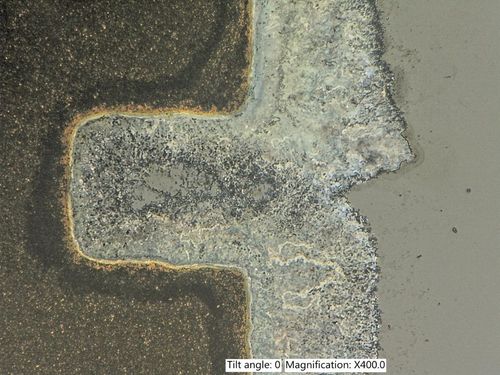
The practical question is not, “Is this flux classified as no-clean?” It is, “What evidence shows that the residue produced by this process is acceptable on this assembly?”
What a Defensible Characterization Study Looks Like
To build a defensible case for leaving residue in place, you need all three elements plus the J-STD-004 revision the flux was qualified against. With that, you can decide whether the residue is acceptable as agreed between user and supplier (AABUS), needs cleaning, needs SIR validation, or needs both.
Start With the Actual Materials and Process
Acceptable flux residue is not a universal number. It is the documented output of a characterization study that you can defend to a customer or auditor and sustain in production.
If you are building that case, start here:
- Read the whole J-STD-004 code. Composition, activity, and halide content, plus the revision, not the word "no-clean."
- Put your worst parts on the test vehicle. QFNs, BTCs, BGA/CSPs, low-standoff caps, and tiny passives, or the study understates risk.
- Anchor on SIR. Use it as the functional gate, with site-specific extraction and IC to explain any failure.
- Design the cleaning process as part of the experiment. Vary agent, equipment, and parameters against the worst-case standoff.
- Keep it qualified. Use process control systems and ROSE-based SPC, tied to limits set during characterization.
Cleanliness is a property of the material set, the package geometry and the process together. Characterize all three, and the flux classification becomes a useful starting point instead of a risky shortcut.