Selective Soldering is preferred over manual and wave soldering because it offers higher precision and consistency for mixed-technology PCBs. The selective soldering process is a precise method for soldering specific through-hole components on the PCB. It involves fluxing, preheating, soldering, and inspection.
The PCB is placed into a fixture to position and expose the soldering areas to the selective wave. Flux is applied to the targeted solder pads using spray, drop jet, or micro-jet application systems. A hydrophobic flux is preferred to avoid overspray, which can cause contamination and reliability issues. Controlled preheating activates the flux and helps drive off solvents and moisture.
Selective solder flux can contribute to leakage currents and ECM (Electrochemical Migration) failures on no-clean assemblies if flux residues are not fully activated. Risk occurs when the selective soldering flux wets and is left under neighboring components. These residues can remain conductive and hygroscopic, creating leakage paths that lead to dendritic growth and eventual ECM failures.
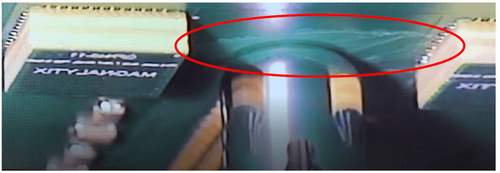
In Figure 1 below, notice how the flux wets to neighboring components. As the flux spreads, the risk arises when it interacts with No-Clean flux residues left under neighboring components that are not heat-activated.
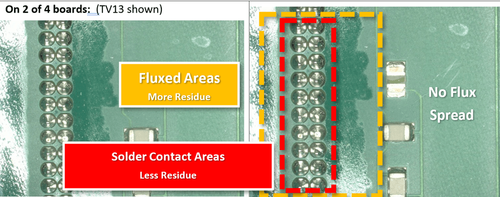
At solder contact areas, the flux decomposes, resulting in low levels of flux residue. When the flux wets away from the solder contact point, the flux residue is sticky, wet, and pliable (Figure 2). The risk occurs when flux wets the component termination.
Mitigation Strategies
• Optimize Flux Application – Minimize over-spray and ensure flux is applied only where soldering occurs.
• Control Preheat & Dwell Time – Ensure flux residues are fully activated and rendered non-conductive.
• Nitrogen Atmosphere – Reduces oxidation and helps limit dross and contamination.
• Post Soldering Cleaning – Even with no-clean flux, cleaning may be necessary.
• Reliability Testing – Mixed technology SIR test boards and SIR testing are the best method for validating that the selective soldering process is reliable.