
Flux residues trapped under QFN bottom terminations pose a well-documented reliability risk because the extremely low standoff prevents proper outgassing. This can lead to leak currents, electrochemical migration, dendritic growth, and long-term field failures. Harsh climatic environments combine heat and moisture to put this problem in motion.
Using Glass-based QFN SIR (Surface Insulation Resistance) chiplets (components) provides a uniquely powerful way to see, quantify, and control flux and process contamination levels that would otherwise remain hidden under bottom-terminated components. These transparent structures make contamination behavior visible during humidity, temperature, and bias testing, enabling far more accurate determination of acceptable flux levels and process cleanliness.
These test vehicles allow engineers to observe how flux residues spread and pool beneath the bottom termination of the QFN component. Notice how the flux residues accumulate next to the thermal lug. Flux residues bridge many of the signal pads
The glass QFNs accurately expose the electrochemical failure mechanisms. These failure modes are often “no-fault-found” issues in the field because they occur in hidden areas.
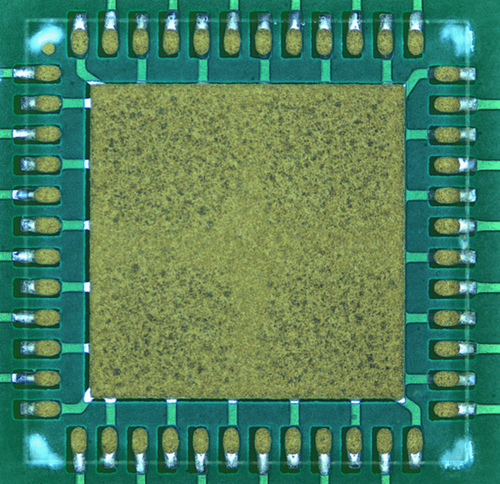
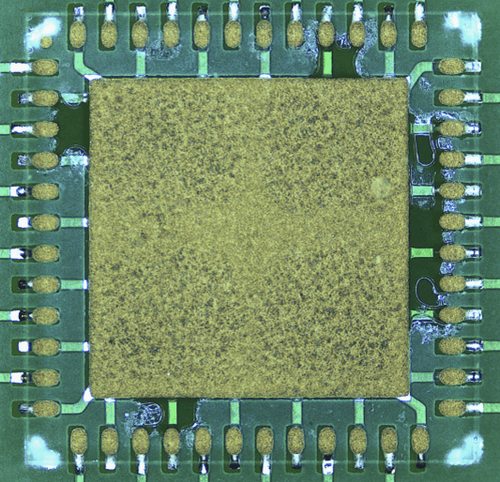
These faux components give assemblers something they’ve never had before – direct visibility into what their cleaning process is doing under a bottom-terminated component. That visibly makes it dramatically easier to set, tune, and validate cleaning parameters using real evidence rather than guesswork.
Glass QFNs provide assemblers with direct visibility and electrical validation, allowing them to tune cleaning parameters with precision. Instead of relying on assumptions or external cleanliness tests, they can observe real behavior under real QFN geometries and set process windows that are both reliable and efficient.