
Organic acid (water-soluble) fluxes used in electronics are composed of polar molecules – primarily weak organic acids – dissolved in highly polar solvents such as water or water/alcohol blends. Their polarity is essential for oxide removal, ionic mobility, and post-solder cleaning.
Water-soluble (OA) flux residues must be cleaned using a controlled water-based cleaning process – typically a heated deionized (DI) water wash followed by a thorough rinse and drying. This type of flux is highly active and ionic, so cleaning is mandatory for high-reliability assemblies.
Deliquescence refers to a substance’s ability to absorb moisture from the atmosphere until it dissolves into an aqueous solution. This is a well-known behavior of hygroscopic materials, which readily absorb water and can solubilize under sufficiently high humidity.
Surface Insulation Resistance (SIR) testing evaluates the long-term reliability of boards soldered with water-soluble fluxes and cleaned by exposing circuits to controlled temperature, humidity, and electrical bias. To illustrate, a contract manufacturer soldered and populated the MGX B-52 Legacy 2 SIR test board using a water-soluble solder paste and cleaned the board post-soldering in an Inline cleaning machine with DI water.
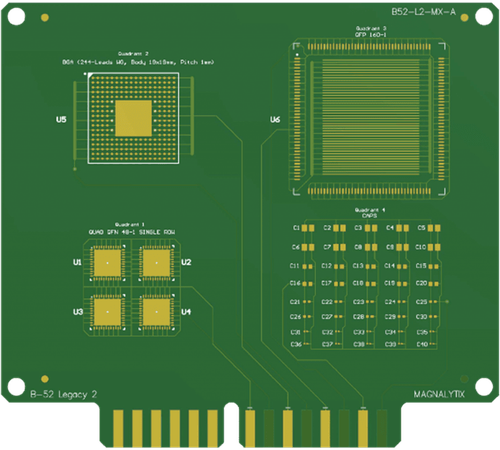
The QFN, FBGA, and QFP-160 failed SIR testing. In this instance, trace flux residue was observed under the component terminations. Water-soluble flux residue is ionic and highly deliquescent. During SIR testing, the water-soluble flux residue dissolved into moisture monolayers, creating a current that lowered insulation resistance in the failure zone.
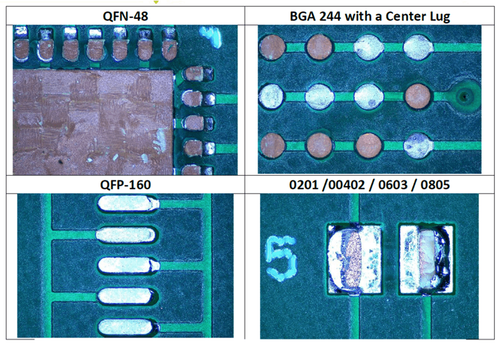
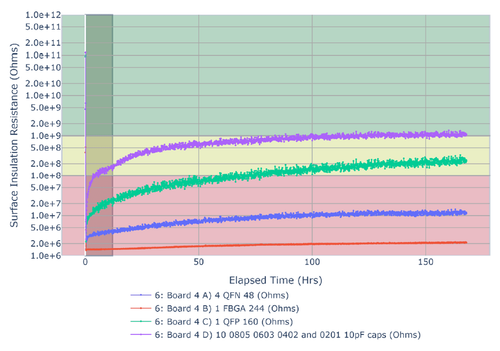
Trace flux residues under bottom-terminated components are not always visible. However, SIR testing is highly effective in characterizing materials and cleaning processes. Using this method to dial in the cleaning process can ensure the complete removal of water-soluble flux, improving reliability.